

Learning to Fly...
Share or comment:
[apss_share]
When Hannah Finch lost her dearly-loved cousin in an air crash, she developed a fear of flying, until she sought help from a most unusual source...
Hannah says: For years I had flown happily, climbing on board planes as easily as getting on a bus. But then something happened that handed fear a trump card. In August 2010, my cousin Jeremy was killed in a plane crash. He was 31. We were the same age.
While I was setting out on married life, Jeremy was planning on conquering the highest peaks in the world. He had left his natural medicine practice in Cape Town, South Africa, to travel the globe. He spent a year trekking in South America, then toured the Far East before arriving in Nepal.
It was on a flight from Kathmandu to Lukla airport, near Everest base camp and one of the most dangerous landing strips in the world, that he was killed, along with 13 passengers and crew. He had planned to hike the Annapurna mountain circuit to hone his climbing skills for attempts on Mount Kilimanjaro and Everest the following year. But it wasn’t to be.
"In the aftermath of his death, I promised myself I would never fly again."
I knew Jeremy best when we were children. He lived in Cape Town, South Africa but would spend summers with us in Torquay. Even then he had sprite-ish spirit and eyes shining for adventure. So it came as no surprise when it emerged that he had extended his visa to take the flight that had been grounded for days on end due to poor weather. It was a fateful mistake but one that was so natural to make for a person who was so determined to really live.
I now know that the flight, operated by Agni Air, took off from Kathmandu but was forced to turn back in bad weather. It crashed close to Shikharpur village, 50 miles from Kathmandu.
I first heard what had happened on Radio Four during my lunch hour. The newsreader said a Briton, Jeremy Taylor, living in South Africa, had been killed. It is a reasonably common name, of course. But my gut told me it was him.
And yet, the experience was too extraordinary. How can you hear of the death of someone you love delivered so flatly and for everyone to digest?
In the aftermath I somehow got to promising myself that I would never fly again, and while I was fractured the fear seeped in. But if I had known what terrible bargain I had made to appease a scared and horrified self, I would have chosen differently.
One reason that I love Jeremy is because he chose to live, right up until the end. And I promised him that I would use his courage to fuel my own adventures. And yet, I have been held back by my irrational fear.
And, though few of us will lose loved ones in this way, a fear of flying affects one in six people. That’s why, five years after losing Jeremy, I went to seek help from Captain Andrew Wilkins, founder of the Virtual Jet Centre in Chudleigh, Devon.
Andrew has worked as a commercial pilot for more than 30 years, flying both Airbus and Boeing Aircraft, and has trained and examined commercial airline pilots.
Every day, he works with professional air crews, meets enthusiasts and offers a Fear of Flying course to help those of us who are terrified of even peeking around the door of the mock-up cabin.
He tells me that whatever I’m feeling is completely normal. I’m not alone. Indeed, Andrew has already helped more than 100 people like me on his courses. They go on to feel more confident about being on an aircraft. He shows that I can achieve the same.
I start by telling him about my anxiety and what happened to Jeremy. But he doesn’t flinch, like I thought he would. Like I do. Through our discussions, I come to realise that Jeremy’s crash is not the cause of my phobia but a tragedy upon which to hang my anxiety. It is a loss so profound and absolute, it has been hard to disentangle the past event from the ongoing fear.
The key for me, says Andrew, is coming to a place of acceptance of what has happened. He explains that Jeremy’s small plane was, most likely, caught in a down draught in the most mountainous and volatile flying region in the world. It couldn't be further from the world of commercial aviation, which is so regulated that the captain and first officer can’t even have the same chocolate bar for fear of poisoning.
But it is only by examining this jumble of thoughts and fear that I can come to a kind of understanding. There is a job to be done, teasing apart the re-occurring anxiety from what is already in the past.
I feel it at the prospect of booking the flights. I have a stomach lurch when I pack the suitcase.
"It took two diazepam and a Bloody Mary to face a morning flight to Edinburgh."
The wait at the airport feels grindingly ominous. I feel anxious right now, just writing about it. Andrew explains: “I don’t say that this course is a cure. You can’t cure a fear like this in three hours. But it is a start of the process of managing the fear.”
Seeking help has been a long time coming. It was when downing two diazepam and a Bloody Mary for a morning one-hour flight to Edinburgh that I finally accepted I had a problem.
Why is it that people seem so relaxed in the departure lounge when I have a lone tear trickling down my face? Andrew nods his head knowingly. He has heard all this before.
“Before 9/11 I used to allow nervous passengers to sit in the jump seat on the flight deck but aviation rules completely changed after that."
“I have always wanted to help people and enjoyed that element in my work. That’s why the Virtual Jet Centre really has been my career highlight. To help people to let go of fear completely opens the world to them and it also helps in tackling other areas of life.”
Success on the course means people go away feeling more confident about flying on an aeroplane. And the beauty of the simulator is that you get to experience flying from a pilot’s point of view, the place of control.
"And then we are away and I am in control, above clusters of houses and trees."
The simulator itself is a replica of a Boeing 737-800. I ‘fly’ it from Heathrow to Manchester. It is very convincing indeed. I am so terrified at take-off, even though we are never more than a foot from the ground, that I hold my breath. I am crying.
“You OK?” asks Andrew, putting his hand on my shoulder.
“Yes,” I say wiping my tears away, nervously laughing.
I hate take-off. This is the point on a flight when I am waiting for the engines, whirring horribly fast, to burst into flames. But it doesn’t happen. And then we are away and I am in control, choosing the acceleration, in charge of the height. All is calm. It is a beautiful sunny day. I can see clusters of houses and miles of fields and hedgerows.
“I noticed that by the time we got to 6,000ft your face changed,” observed Andrew. “You looked like you were smiling.” It’s true. Flying the thing is definitely more fun than being in the cabin. There are so many switches and dials to think about that by the time we hit our virtual turbulence, I’m settling in. When I ‘land’ the plane at Manchester, it is hard to believe that 50 minutes have passed. I know now what all those scary noises are, how the wing flaps create drag and the sound that the engine makes when starting up.
I didn’t tell Andrew this at the time but, for a fleeting moment, when we were in mid-flight above the world, I had a thought that perhaps I may want to come back to ‘fly’ this plane again. Then there is a little zing of joy when I wonder whether one day, I could learn to fly, really fly. Perhaps it is being a passenger I’m frightened of, rather than flight itself.
Can you imagine that, Jeremy? Would you be proud? As proud of me, I hope, as I always will be of you.
With sincere thanks to the Virtual Jet Centre.
Portraits by: Rachel Taylor
Need our help? Book Now!


One-to-one Support
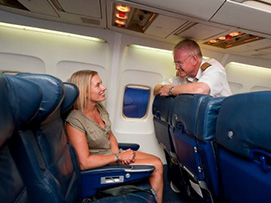
On our fear of flying course, Captain Andy Wilkins works with people on a one-to-one basis about their individual fears, and tries to offer an insight into their specific fear(s).
Most fear of flying courses are run by large airline companies, thereby automatically taking away the element of allowing you to feel calm and peaceful even before you start.
However, our brand new virtual flight centre located in beautiful Devon countryside has every technology to give you a realistic experience of flying but in a relaxed and nurturing setting.
If further support is necessary, we can also offer the services of a local therapist.
(Right) Hannah Finch attends Virtual Jet Centre for our Fear of Flying Course.
Share or comment:
[apss_share]
